Remember Clippy? Well, if you were using Microsoft Word between 1997-2001, you probably do. He was Microsoft Virtual Assistant, along with these below.
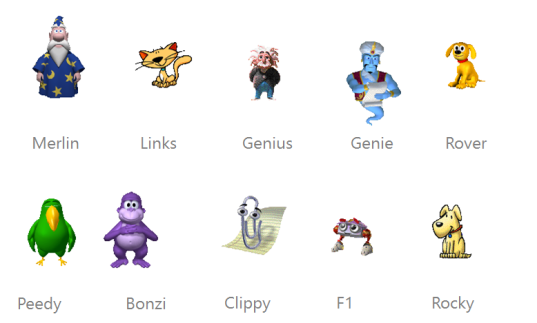
It’s been quite sometime since programers started developing virtual assistants. Back then, these assistants were created to create a “human” aspect of the computer interface, giving them animations, character, and personality. In theory, it made it “easier” or “more fun” to use computers.
Now, we have a whole handful of programs that do a similar job known as Siri, Alexa, Echo, Cortana, and Google Assistant. The purpose of these only slightly evolved into giving the internet that human aspect, instead of the computer by eliminating the visuals and animations. Similar to Peedy in the YouTube video below, Alexa is known to find thousands of songs, just 10x better and faster.
Virtual assistants are also getting a lot of attention due to the improvement of internet accessibility for persons with disabilities, like blindness (Goddard, 2018) and speech impediments (Medeiros, 2018). This greatly affects education and students’ learning success by allowing people to utilize virtual assistants for reading, writing, research, and communication.
Although technology has progressed, the AI programming for these virtual assistants mentioned above have a long way to go. Some challenges include inaccurate speech recognition and irrelevant searches. In addition, AI cannot learn and incorporate predictive analytics…yet.
Because it’s becoming more common to rely on virtual assistants in daily life, I think virtual assistants will be included in education relatively soon, not just for persons with disabilities. I think the technology is there and will continue to progress, now it’s just about when schools will have the money or push to implement this technology.
 Learning with Emerging Tech: Critical Trends